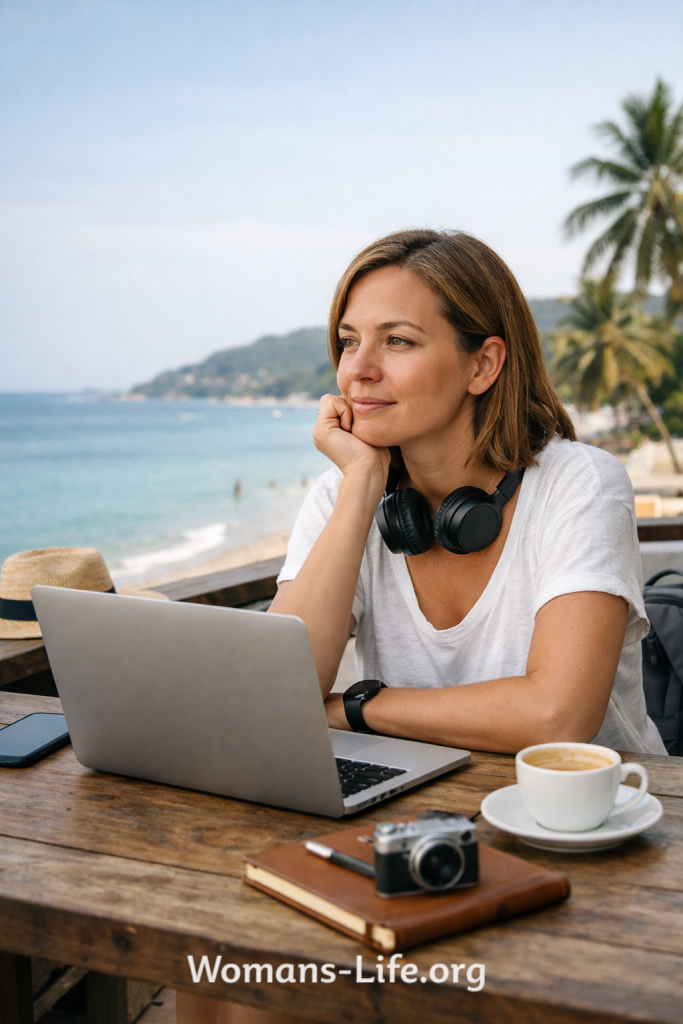

You’re in a meeting that could have been an email. Your coffee’s gone cold. Somebody’s screen is sharing a spreadsheet nobody asked for. And somewhere in the back of your mind, you’re remembering a photo you saw last week — a laptop on a wooden table, a window open to some sun-drenched street you didn’t recognize, and a caption that said something like “office for the day.” You found yourself staring at it longer than you meant to.
That quiet pull has a name. And more people are following it than you might think.
What Is a Digital Nomad, Exactly?
The simplest answer is this: what is a digital nomad if not someone who has untethered their income from a fixed location? They work remotely — using a laptop, an internet connection, and whatever tools their profession requires — while living somewhere other than where their employer, clients, or customers are based. Sometimes that somewhere changes every few weeks. Sometimes it’s the same city for a year. The defining feature isn’t constant movement. It’s the absence of a required address.
The term has roots in a 1997 book by Tsugio Makimoto and David Manners, who predicted that advances in technology would one day allow people to work from anywhere. What felt like science fiction then has become, for 18.1 million Americans alone as of 2024, an ordinary Tuesday. The pandemic didn’t create the digital nomad — it simply removed the last barrier between people who wanted the lifestyle and the permission to try it.
A digital nomad isn’t running away from something. They’re running toward a different definition of what a working life can look like.
It’s worth separating the concept from the cliché. What is a digital nomad in real terms? Not necessarily someone doing yoga on a clifftop between Zoom calls. The majority describe themselves as writers, designers, developers, marketers, consultants, and programmers. They are, overwhelmingly, skilled professionals who have figured out how to do the same work they’d otherwise be doing in an office — just somewhere else. Seventy-five percent are Millennials or Gen Z, though the lifestyle spans generations. One in six earns more than $75,000 a year. This is not a gap year dressed up in a hashtag.
What Is a Digital Nomad Lifestyle Actually Like Day to Day?
Here’s the thing — a typical day looks less like a travel documentary and more like working from home, except the home changes. You wake up, make coffee, open the laptop. You answer emails, join calls, meet deadlines. The work is the work. What shifts is everything around it. The walk you take at lunch is down a street you’ve never seen before. The place you go to think is a café where nobody knows your name. The view from your desk, when there is one, might be extraordinary.
What is a digital nomad choosing when they choose this life? Mostly, they’re choosing flexibility and the slower kind of travel — the kind where you actually live somewhere rather than tick it off a list. Popular destinations tend to offer a combination of affordable living costs, reliable internet, and a community of other people doing the same thing. Lisbon, Chiang Mai, Medellín, Tbilisi, and Bali have all become well-known hubs. Most countries with digital nomad visa programs — and there are now more than 67 of them — allow stays ranging from six months to a few years, making it possible to genuinely settle in rather than just pass through.
Co-working spaces have changed the texture of this life considerably. They’ve turned what used to be an isolating experience into something more social — a place to show up, sit next to other people, have a conversation over lunch that isn’t conducted over Slack. For many, they’ve become the closest thing the lifestyle offers to a regular office, without the commute or the mandatory team-building exercises.
The Part Nobody Puts in the Caption
Understanding what is a digital nomad means sitting with the harder parts too, because they’re real and they matter.
Loneliness is the challenge most consistently reported by people living this way, and it makes sense when you think about it. Human connection takes time to build, and time is the one thing that constant movement doesn’t offer in abundance. The relationships that sustain most people — the ones formed over years, through proximity and repetition — are genuinely harder to maintain when you’re several time zones away and your address changes every month. Some people find the community of other nomads fills that gap. Others discover, sometimes painfully, that it doesn’t.
Income inconsistency is another reality worth naming honestly. What is a digital nomad’s financial life, realistically? For many, it means freelance or contract work, which means feast-and-famine cycles, no employer-sponsored retirement plan, no paid leave, and no sick days that don’t cost you something. Over half identify as self-employed, and 42% as freelancers or gig workers. The freedom is real — so is the financial variability that comes with it.
The freedom to work from anywhere is genuinely extraordinary. So is the responsibility that comes with building that freedom yourself.
There’s also a broader conversation worth having, one that doesn’t get enough space in the breathless lifestyle content. When large numbers of remote workers — typically from higher-income countries — move to lower-cost cities and neighbourhoods, rent prices rise. In some areas of Mexico City, rents have jumped more than 60% in recent years, pushing long-term residents out of neighbourhoods they’ve lived in for generations. What is a digital nomad’s relationship to the places they inhabit? It’s a question the community is genuinely grappling with, and there’s no comfortable answer. Spending locally, learning the language, staying longer, and engaging meaningfully with a place rather than consuming it — these are the choices that begin to address it.
What Is a Digital Nomad Asking Themselves Before They Start?
Usually this: can I actually do my job from anywhere? The honest answer for most people with knowledge-based work is yes — and increasingly so. Writers, editors, developers, designers, social media managers, consultants, accountants, virtual assistants, online educators, and customer service professionals have all built nomadic careers. If your work happens on a screen, the screen can be anywhere.
Beyond the practical question, there’s a more personal one. Does the trade-off actually appeal to you? Because what the lifestyle gives you in freedom and new experience, it takes back in stability, roots, and the particular comfort of being known in a place. Some people find that exchange exhilarating for years. Others discover they miss their people more than they expected, or that they need more structure than a changing backdrop provides. Neither response is wrong — they’re just honest. The people who thrive longest tend to be those who chose the lifestyle deliberately rather than impulsively, who tested it before committing, and who built systems around the parts that don’t come naturally.
What is a digital nomad, in the end? Someone who decided that the traditional arrangement — your life in one place, your career in another, and a commute to bridge them — wasn’t the only option. Whether that answer is the right one depends entirely on who’s asking it. But the fact that you’re reading this suggests the question is already alive in you. That’s usually where the interesting decisions begin.
The laptop on the wooden table isn’t a fantasy. It’s a choice. And like all real choices, it comes with everything that choosing means.


